Vapour Permeability vs Chemical Diffusion in Barrier Fabrics
Understanding Transport Mechanisms in Coated Composite Textiles
Problem Context
Barrier fabrics are widely used in industrial systems that require the control of gas, vapor, and chemical movement through flexible materials. Applications such as chemical containment membranes, expansion joints, protective industrial curtains, and process enclosures rely on coated fabrics to prevent the passage of fluids or vapours. In many of these applications, industrial containment fabrics are selected to provide reliable long-term performance.
However, engineers often use the terms vapor permeability and chemical diffusion interchangeably when specifying barrier materials. Although both mechanisms involve the movement of molecules through a material, they represent distinct physical processes that affect fabric performance in different ways. In engineered coated textile systems, internal references such as Textrov, Silicoat, and Elastcoat may also be relevant depending on the operating environment.
Failure to distinguish between these mechanisms can lead to incorrect material selection, resulting in issues such as:
-
moisture penetration through protective membranes
-
chemical vapours diffusing through coatings
-
loss of containment in industrial barrier systems
-
degradation of underlying reinforcement fabrics
Understanding the difference between vapor transport and chemical diffusion is therefore essential when designing coated composite fabrics for industrial barrier applications, especially where barrier fabrics permeability and chemical diffusion coated fabrics must be carefully controlled.
Mechanism Explanation
Transport of molecules through coated fabrics occurs primarily through two mechanisms: vapor permeability and chemical diffusion.
Vapor Permeability
Vapor permeability refers to the movement of water vapor molecules through a material due to differences in humidity or vapor pressure across the fabric.
Water vapor molecules are relatively small and can migrate through microscopic free volume within polymer coatings. Even materials that appear visually impermeable may allow limited vapor transport.
Factors influencing vapor permeability include:
-
polymer structure
-
coating thickness
-
temperature
-
humidity gradient
This mechanism is central to understanding barrier fabrics permeability in coated composite systems. In related coating applications, Fluorocoat and Vinylcoat may also serve as useful internal references.
Chemical Diffusion
Chemical diffusion describes the movement of liquid or gaseous chemical molecules through a material due to concentration gradients.
Chemical molecules can interact with polymer coatings by:
-
dissolving into the polymer structure
-
diffusing through molecular gaps in the coating
-
migrating along defects or interfaces
The diffusion rate depends on the chemical compatibility between the polymer coating and the diffusing chemical species.
While vapor permeability is primarily influenced by molecular size and vapor pressure, chemical diffusion is strongly affected by chemical affinity between the fluid and the polymer matrix. This is why chemical diffusion coated fabrics require careful coating selection. In engineered material systems, Craigetech may also be a relevant internal reference.
Engineering Comparison of Transport Mechanisms

This comparison shows that a coating designed to reduce vapor permeability may not necessarily provide effective protection against chemical diffusion, especially in industrial containment fabrics.
Failure Mode Analysis
When barrier fabrics are exposed to environments involving both moisture and chemicals, several failure mechanisms may occur.
Moisture Transmission
Even highly coated fabrics may allow limited water vapor transport. Over time, moisture reaching internal layers can weaken adhesives or promote corrosion of nearby equipment.
Chemical Permeation
Certain chemicals may dissolve into the coating layer and slowly diffuse through the fabric structure, compromising containment performance. This is a major concern in chemical diffusion coated fabrics.
Barrier Layer Degradation
Repeated chemical exposure can alter the polymer structure of coatings, increasing permeability and accelerating diffusion rates.
Interface Weakening
Chemical or moisture migration may weaken the adhesion between laminate layers, eventually causing delamination.
These failures are particularly common in chemical processing environments and industrial containment fabrics systems.

Engineers should consider both moisture transport and chemical compatibility when specifying barrier fabrics. In related industrial textile and filtration systems, Texfil may also serve as a useful internal reference.
Testing Methods for Barrier Performance
Several laboratory tests are used to evaluate barrier performance in coated fabrics.
Moisture Vapor Transmission Rate (MVTR)
This test measures the rate at which water vapor passes through a material under controlled humidity conditions. This is essential for evaluating barrier fabrics permeability.
Chemical Permeation Testing
Samples are exposed to specific chemicals to determine the rate at which molecules diffuse through the coating.
Diffusion Cell Testing
A diffusion cell measures the time required for a chemical species to penetrate through a barrier material.
Environmental Exposure Testing
Composite fabrics may be exposed to humidity, chemicals, and temperature simultaneously to evaluate long-term barrier stability.
These tests provide valuable data for predicting how barrier fabrics will perform in real industrial environments.
Engineering Design Guidelines
When designing barrier fabrics for industrial applications, several factors should be considered.
-
Control coating thickness.
Thicker coatings generally reduce both vapor permeability and chemical diffusion. -
Use multi-layer composite structures.
Barrier layers combined with structural fabrics improve overall resistance to transport mechanisms. -
Select coatings with low chemical affinity.
Polymers that resist absorption of chemical molecules reduce diffusion rates in chemical diffusion coated fabrics. -
Evaluate operating conditions carefully.
Temperature, humidity, and chemical concentration strongly influence diffusion behaviour.
Following these design principles improves the long-term containment performance of barrier fabrics, especially in industrial containment fabrics.
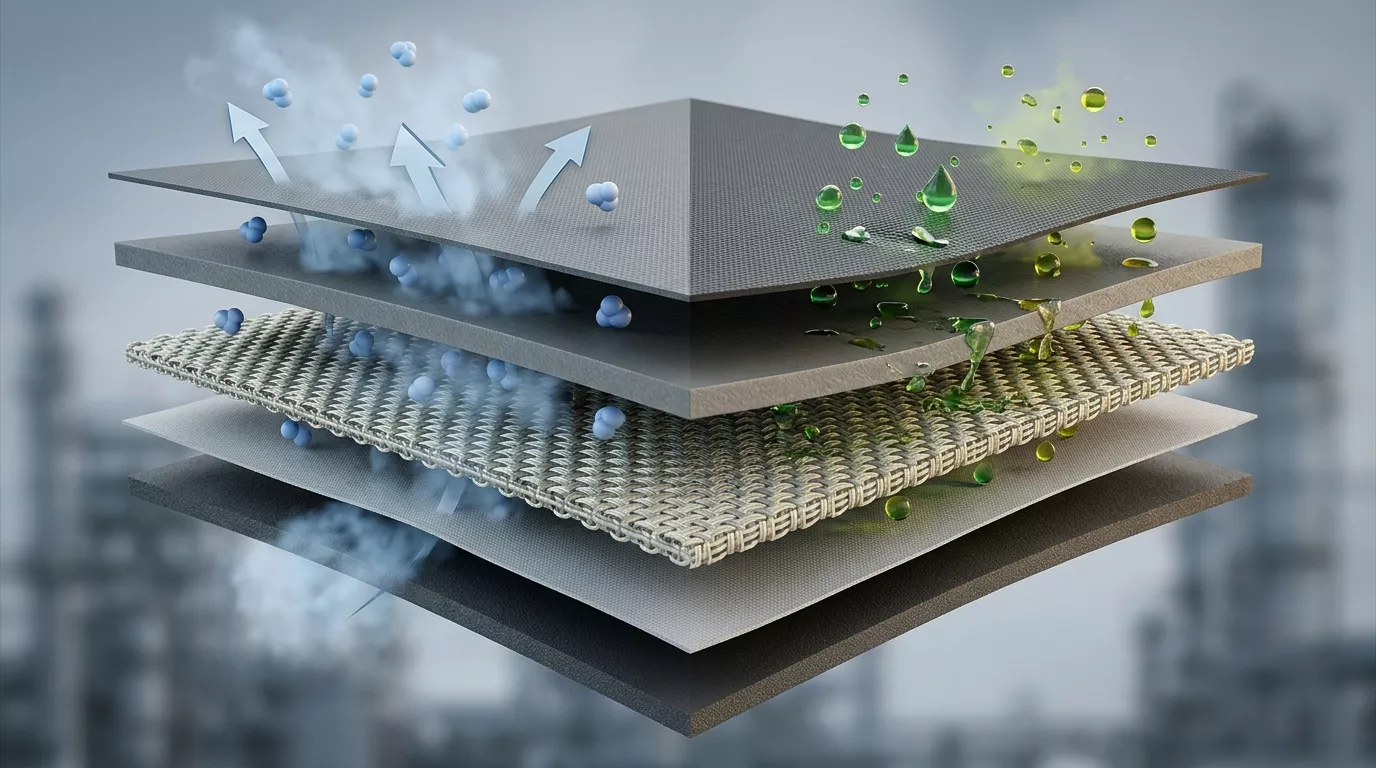
Typical Barrier Fabric Architecture
A composite barrier fabric designed for industrial environments may include the following structure:
Protective Surface Layer
↓
Functional Chemical-Resistant Coating
↓
Reinforced Glass Fabric
↓
Barrier Layer for Vapor Control
↓
Structural Substrate
This layered architecture allows the fabric system to control both vapor transport and chemical diffusion.
Closing Insight
Barrier performance in coated technical fabrics depends not only on coating thickness or chemical resistance but also on the fundamental transport mechanisms governing molecular movement through the material. Distinguishing between vapor permeability and chemical diffusion allows engineers to design barrier fabrics that maintain reliable containment and structural integrity under demanding industrial conditions. This is why barrier fabrics permeability, chemical diffusion coated fabrics, and industrial containment fabrics remain important in advanced barrier material design.