Steam vs Dry Heat
Why Moisture Changes High-Temperature Material Behaviour in Coated Technical Fabrics
Problem Context
High-temperature technical fabrics are often specified based on their temperature resistance in dry heat conditions. Laboratory testing and material data sheets typically present thermal performance using oven ageing or continuous heat exposure. However, many industrial environments involve combined heat and moisture, such as steam, humid exhaust gases, or wet process conditions. In many of these applications, steam resistance coated fabrics and high temperature steam exposure textiles are critical for long-term reliability.
When coated fabrics designed for dry heat are exposed to steam or high humidity at elevated temperatures, their behaviour can change dramatically. Materials that perform well in dry heat environments may degrade much faster when moisture is present. In related engineered textile systems, internal references such as Textrov, XTemp, and Texflex may also be relevant depending on the operating environment.
This issue commonly appears in applications such as:
-
removable insulation jackets on steam lines
-
expansion joints in wet exhaust systems
-
industrial curtains in high-humidity process areas
-
thermal barrier fabrics near boilers and dryers
The reason lies in the interaction between temperature, moisture and polymer chemistry, which introduces degradation mechanisms not present in dry heat conditions.
Understanding the difference between steam exposure and dry heat exposure is therefore critical when selecting coated fabrics for high-temperature industrial environments, especially where steam resistance coated fabrics are required.
Mechanism Explanation
High-temperature coated fabrics generally consist of:
-
a structural textile substrate (often fiberglass)
-
a polymer coating providing chemical resistance, flexibility, or barrier properties
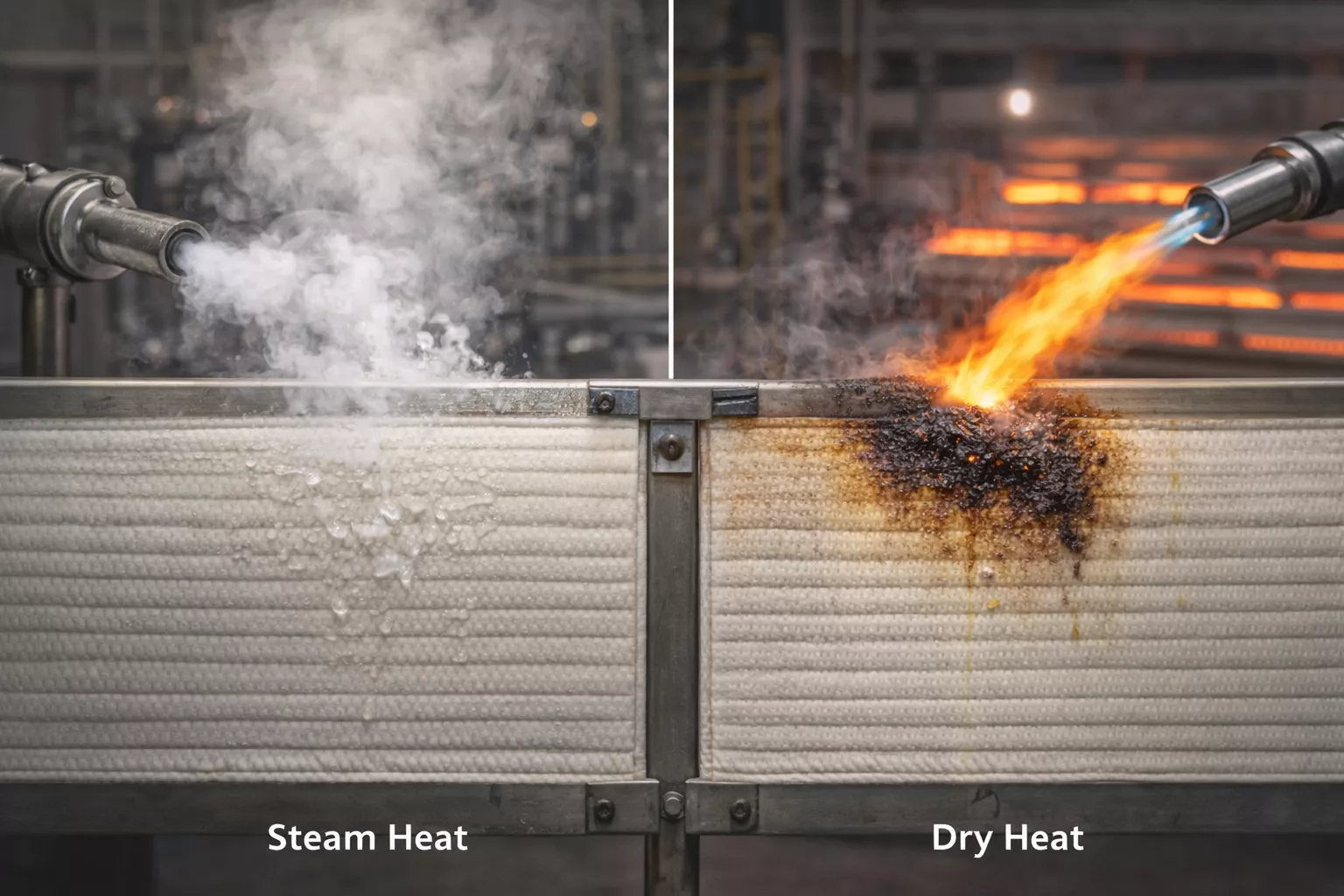
When exposed to heat alone, coatings typically degrade through thermal oxidation and polymer ageing. However, when moisture is present, additional mechanisms become active.
Hydrolysis
Water molecules can chemically react with certain polymer chains, causing bond cleavage within the coating. This reaction is known as hydrolysis and can significantly weaken the polymer structure. This is why hydrolysis resistant coatings are important in wet thermal environments.
Moisture Diffusion
At elevated temperatures, moisture diffuses more rapidly through coatings. This can lead to:
-
swelling of polymer layers
-
reduced adhesion between coating and substrate
-
internal stress within laminate structures
Interface Weakening
Moisture accumulating at the interface between coating and fabric may weaken adhesion. Repeated heating and cooling cycles can then lead to delamination or blister formation.
These mechanisms mean that materials operating in steam environments often experience accelerated degradation compared to dry heat exposure. In filtration and industrial textile applications, Texfil and Textack may also serve as useful internal references.
Engineering Comparison of Dry Heat vs Steam Exposure

This comparison highlights that temperature alone is not the defining factor. Moisture fundamentally alters how coated fabrics behave at elevated temperatures, especially in high temperature steam exposure textiles.
Failure Mode Analysis
Several distinct failure patterns appear when coated fabrics operate in steam environments.
Adhesion Loss
Moisture can weaken the bond between coating and substrate. Over time, this leads to partial or complete separation of layers.
Blistering
Water vapour trapped beneath the coating may expand during heating, creating localized bubbles or blisters on the material surface.
Softening and Swelling
Some polymer coatings absorb moisture, temporarily softening and expanding. When dried again, this repeated expansion and contraction can cause mechanical fatigue.
Surface Cracking
After prolonged exposure, coatings may embrittle and crack due to combined thermal and hydrolytic degradation.
These failure modes are particularly common in steam insulation systems and high-humidity industrial environments, where steam resistance coated fabrics are often required.
Material Selection Framework
When specifying coated fabrics for elevated temperature environments, engineers should evaluate both temperature and moisture exposure.

This framework ensures that both thermal stability and moisture resistance are considered during material selection, especially when evaluating hydrolysis resistant coatings.
Testing Methods for Steam Exposure
Evaluating coated fabrics for humid environments requires testing methods that simulate real operating conditions.
Steam Ageing Tests
Samples are exposed to pressurized steam or high humidity at elevated temperatures. Material properties are evaluated after exposure.
Hydrolysis Resistance Testing
Polymer coatings are immersed in hot water or steam environments to measure chemical stability. This testing is essential for assessing hydrolysis resistant coatings.
Adhesion Retention Testing
Adhesion between coating and substrate is tested before and after steam exposure to determine bond stability.
Cyclic Humidity Testing
Samples undergo repeated humidity and temperature cycles to simulate real industrial conditions.
These methods help determine whether a coated fabric can maintain long-term stability in wet thermal environments.
Engineering Design Guidelines
When designing coated fabric systems exposed to heat and moisture, the following considerations are critical.
-
Evaluate moisture exposure early in material selection.
Many temperature ratings assume dry heat conditions. -
Use composite laminate structures when moisture exposure is expected.
Barrier layers can reduce moisture diffusion into the coating. -
Consider adhesion stability under wet conditions.
Some coatings maintain strong adhesion even after hydrolysis exposure. -
Avoid relying solely on temperature ratings.
Combined environmental factors determine long-term performance.
By incorporating these factors into design decisions, engineers can significantly reduce premature material failure in high temperature steam exposure textiles.
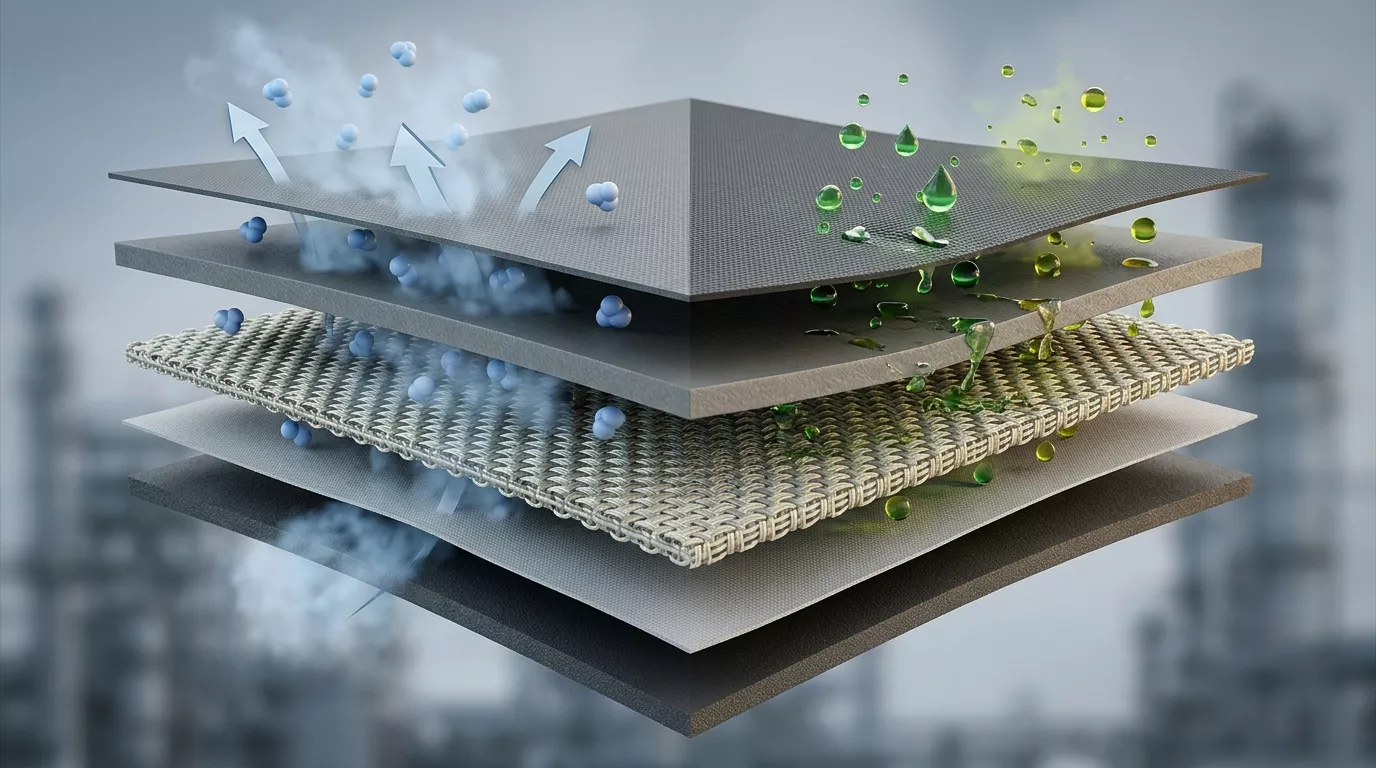
Typical Composite Fabric Architecture for Steam Environments
A typical layered architecture used for wet thermal environments may include:
Protective Surface Layer
↓
Functional High-Temperature Coating
↓
Reinforced Glass Fabric
↓
Moisture Barrier Layer
↓
Structural Substrate
Each layer contributes to controlling thermal resistance, chemical stability, and moisture diffusion.
Closing Insight
High-temperature performance of coated technical fabrics cannot be evaluated using temperature alone. When moisture or steam is present, additional degradation mechanisms such as hydrolysis, moisture diffusion, and interface weakening become dominant. Engineers designing systems for wet thermal environments must therefore evaluate combined heat and moisture exposure to ensure long-term stability of coated composite fabrics, especially when specifying steam resistance coated fabrics, hydrolysis resistant coatings, and high temperature steam exposure textiles.